
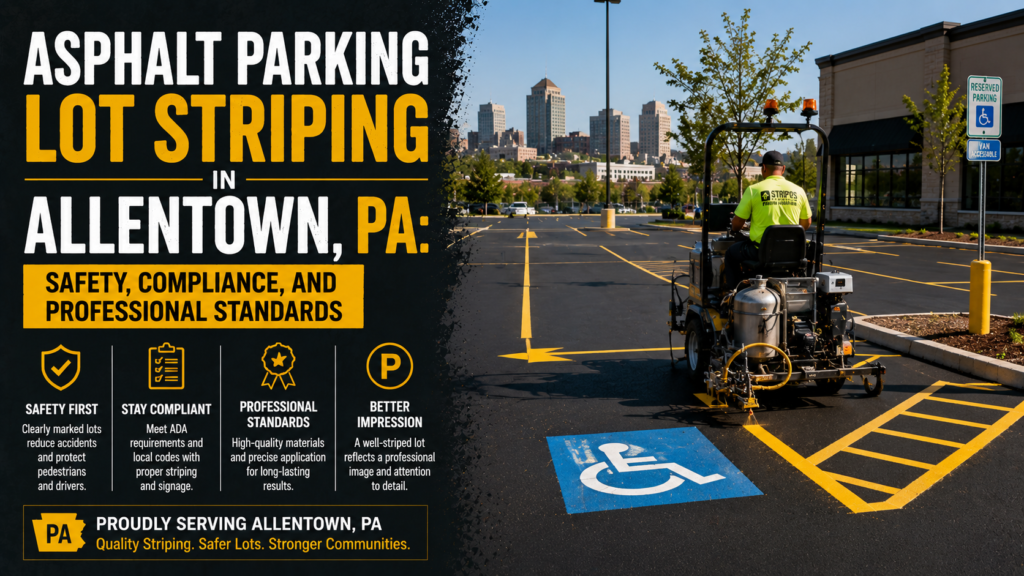
Parking lot striping is one of the most important yet frequently overlooked aspects of property maintenance. For commercial properties, retail centers, schools, places of worship, industrial facilities, and any other location with a parking lot in Allentown, Pennsylvania, clear and properly applied pavement markings are not merely a cosmetic concern they are a legal requirement, a safety measure, and a significant factor in how efficiently and safely the property functions for the people who use it every day.
This article examines the principles and practice of Asphalt Parking Lot Striping Allentown, covering why it matters, what the process involves, the ADA compliance requirements that govern accessible parking, and how to approach ongoing maintenance of pavement markings.
Why Parking Lot Striping Matters
A parking lot without clear markings is not just inconvenient it is dangerous. When drivers cannot clearly see where spaces begin and end, where traffic should flow, where pedestrians should walk, and where loading areas or fire lanes are located, the risk of accidents, congestion, and conflict increases significantly. Well-executed striping organizes the movement of vehicles and people, reduces confusion, minimizes fender-benders, and creates a parking environment that feels safe and professionally managed.
From a liability perspective, property owners who maintain clear, accurate pavement markings are better protected against claims arising from accidents in their parking areas. Faded, missing, or incorrectly placed markings can expose a property owner to legal liability if an accident occurs that proper markings might have prevented. Adequate markings also demonstrate good faith in maintaining a safe property, which matters both in legal proceedings and in the general perception of the business or institution operating on the site.
ADA Compliance: The Legal Baseline for Accessible Parking
The Americans with Disabilities Act, enacted in 1990 and updated with more detailed standards in 2010, establishes federal requirements for accessible parking that apply to any facility that serves the public. These requirements are not optional failure to comply can result in federal civil penalties of up to seventy-five thousand dollars for a first offense and up to one hundred fifty thousand dollars for repeat violations, as well as exposure to civil lawsuits.
ADA requirements for parking lot striping specify the minimum number of accessible spaces based on the total number of spaces in the lot. For example, a lot with one to twenty-five spaces must provide at least one accessible space, and that space must be van-accessible. Larger lots require a proportional increase in accessible spaces, with at least one in every six accessible spaces being van-accessible.
Van-accessible spaces must be at least eight feet wide with an adjacent eight-foot access aisle, for a total width of sixteen feet. Standard accessible spaces must be at least eight feet wide with a five-foot access aisle. These access aisles the striped areas alongside accessible spaces must be clearly marked, typically with diagonal stripes, to discourage their use as parking spaces. They provide the room needed for wheelchair lift deployment and safe egress from vehicles.
Each accessible space must be marked with the International Symbol of Accessibility, and a sign identifying the space must be posted at least five feet above the ground surface. Many states and municipalities have requirements that go beyond the federal ADA minimum, so property owners in Allentown should confirm compliance with both Pennsylvania state requirements and any city-specific ordinances that may apply.
The Striping Process
Professional parking lot striping begins with layout planning, not with paint. A skilled contractor evaluates the lot’s total square footage, traffic flow patterns, building entrance locations, and existing features to design a layout that maximizes the number of spaces while ensuring safe and efficient vehicle movement. Standard parking stalls are typically nine feet wide by eighteen feet long, but site conditions and local regulations may influence these dimensions.
Surface preparation is the next critical step. New pavement must be allowed to cure fully before striping applying paint to fresh asphalt that has not finished off-gassing oils will result in adhesion failure. For existing lots, the surface must be clean and dry before paint is applied. Painting over dirt, dust, oil, or flaking old markings produces markings that fail prematurely.
Paint application is performed using professional airless spray equipment, which delivers consistent line width, sharp edges, and uniform coverage. High-quality traffic paint is used, with waterborne acrylics being common for standard applications and thermoplastic materials used where exceptional durability and retroreflectivity are required. Retroreflective glass beads are often incorporated into the wet paint to improve nighttime visibility by reflecting headlight beams back toward drivers.
Following application, a final inspection confirms that every marking meets the layout specifications and quality standards, including ADA compliance checks on accessible spaces and signage.
When to Restripe a Parking Lot
Pavement markings in Allentown’s climate are subject to UV degradation from summer sun, abrasion from vehicle traffic and winter maintenance equipment, and the general weathering that accompanies four seasons of varied conditions. Most parking lot markings require restriping every one to three years in high-traffic commercial settings, and every three to five years in lower-traffic areas.
Visual indicators that restriping is needed include markings that have faded to the point where they are difficult to see in daytime, markings that are entirely invisible at night or in wet conditions, line edges that have blurred due to wear, and ADA symbols or signage that no longer clearly communicate their meaning. It is always better to restripe before markings reach complete failure, as a completely unmarked lot creates immediate safety and compliance risks.
Directional Markings and Safety Features
Beyond parking stall lines and accessible space markings, comprehensive parking lot striping includes a range of directional and safety features. Directional arrows guide drivers through one-way traffic aisles, reducing the confusion and head-on conflicts that arise when traffic flow is ambiguous. Stop bars mark the locations where drivers should stop before entering an aisle from a parking space or approaching a pedestrian crossing.
Crosswalks and pedestrian pathways are particularly important near building entrances, where the interaction between vehicles maneuvering for spaces and people walking to and from the building creates the highest conflict potential. Clear, high-visibility crosswalk markings separate pedestrian and vehicle movement zones, reducing the risk of pedestrian injuries. Fire lane markings and no-parking zones ensure that emergency access routes are maintained and that loading areas function safely.
Conclusion
Asphalt parking lot striping in Allentown is far more than a cosmetic task. It is a foundational element of safe, compliant, and well-functioning commercial and public property. Understanding the ADA requirements that govern accessible parking, the materials and methods that produce durable results, and the maintenance cycles that keep markings legible and effective helps property owners manage this aspect of their facilities responsibly. Professional striping services bring the expertise, equipment, and knowledge of local and federal compliance requirements needed to get the job done right and to keep it right as time and weather take their toll.